“Light and shadow have become one. The brighter the light, the darker the shadow.”
It’s been almost two and a half years in the making, but I’m delighted that the long-gestating Bionicle 2003 collab is finally here! (You can see all of the builds here!) And, this has been one of my longest builds in progress as well — I began in April of 2024, and while I had reasonably complete version of the figure done by August (which a few folks were able to see at BrickFair VA 2024!), when the intended drop date of the collab switched to March 2025, I decided to rework a lot of things. In particular, redesigning the build to integrate with a large base, and structural fixes to support itself better, especially those weighty wings, which was an effort from January through March of 2025. And then, well… my piece was done, but the rest of the collab called for a bit more time.
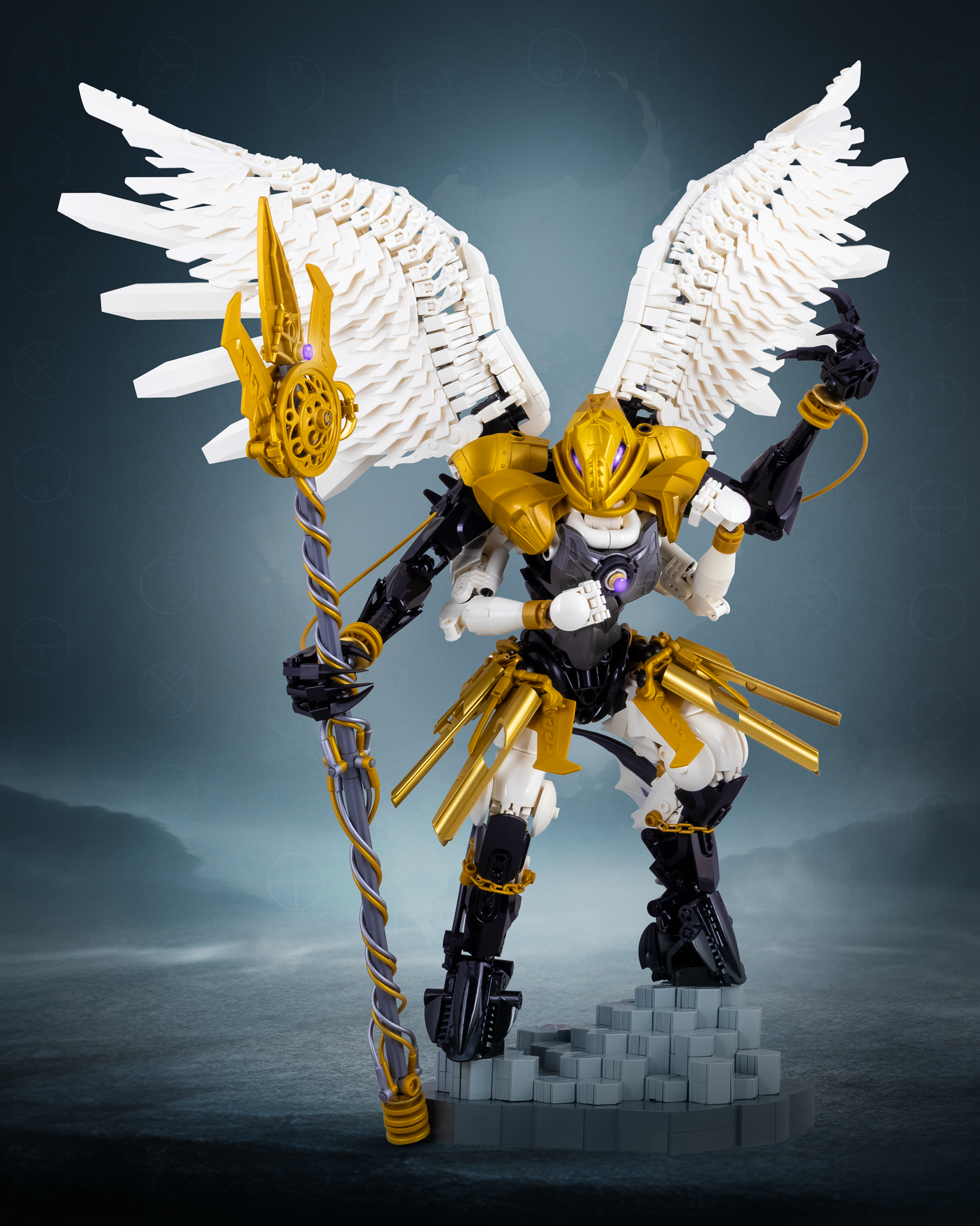
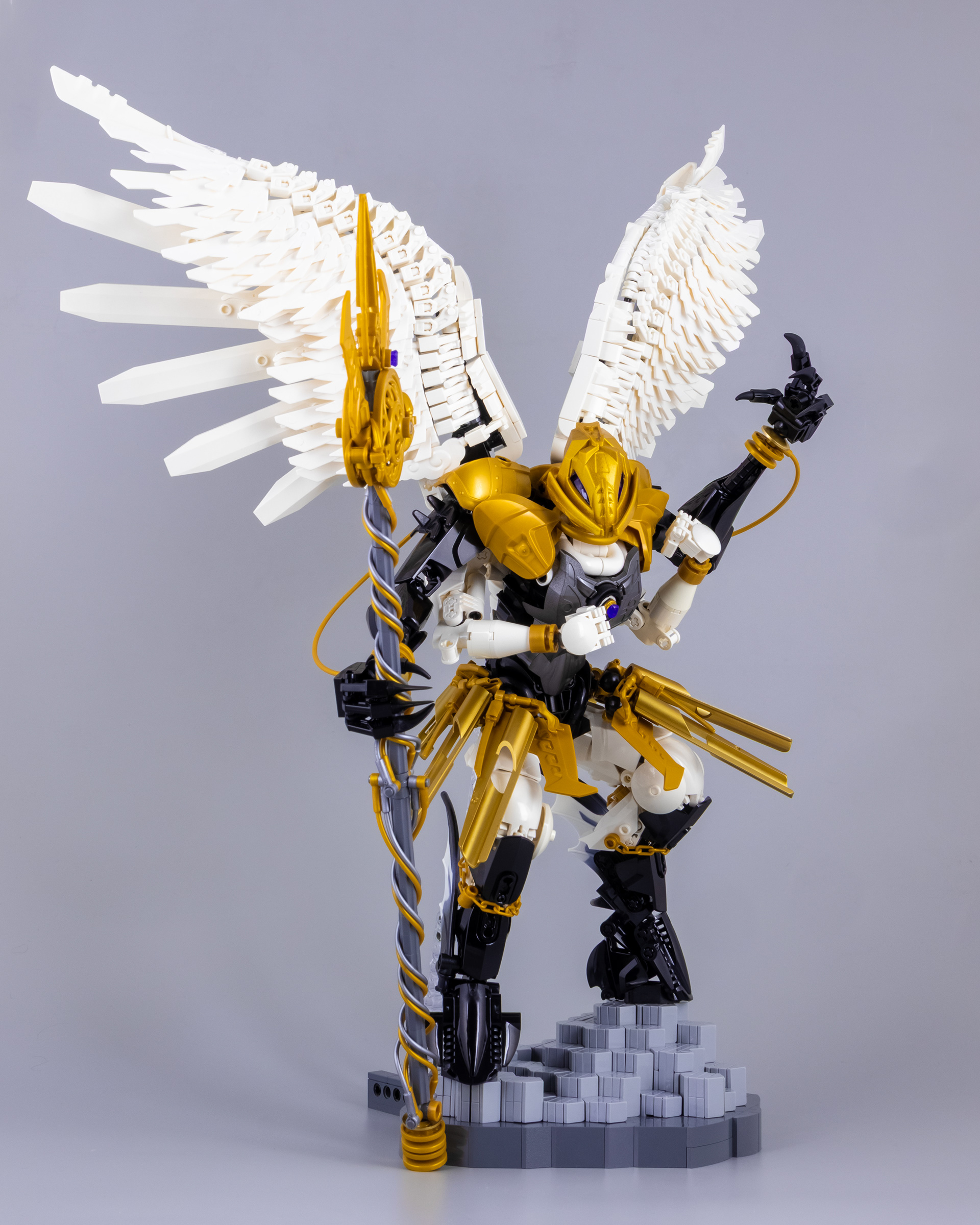
But I’m getting a bit ahead of myself here. Let’s go back to the concept of the build here. For those unacquainted with Bionicle lore, this is a reimagining of the character Takutanuva, a large set released in 2003 as a combination of Makuta (Bionicle’s big bad, and a devil-like archetype) and Takanuva (a white and gold hero paragon), and appears briefly in the story as an unintentional fusion of the two characters. The Takutanuva set itself uses mostly pieces from Takanuva’s vehicle, and frankly looks mostly like a bigger Makuta than a fusion of the two. Clearly, a reimagining would need to show a true mix of the characters — and, I felt, highlight both the demonic and angelic aspects of them.
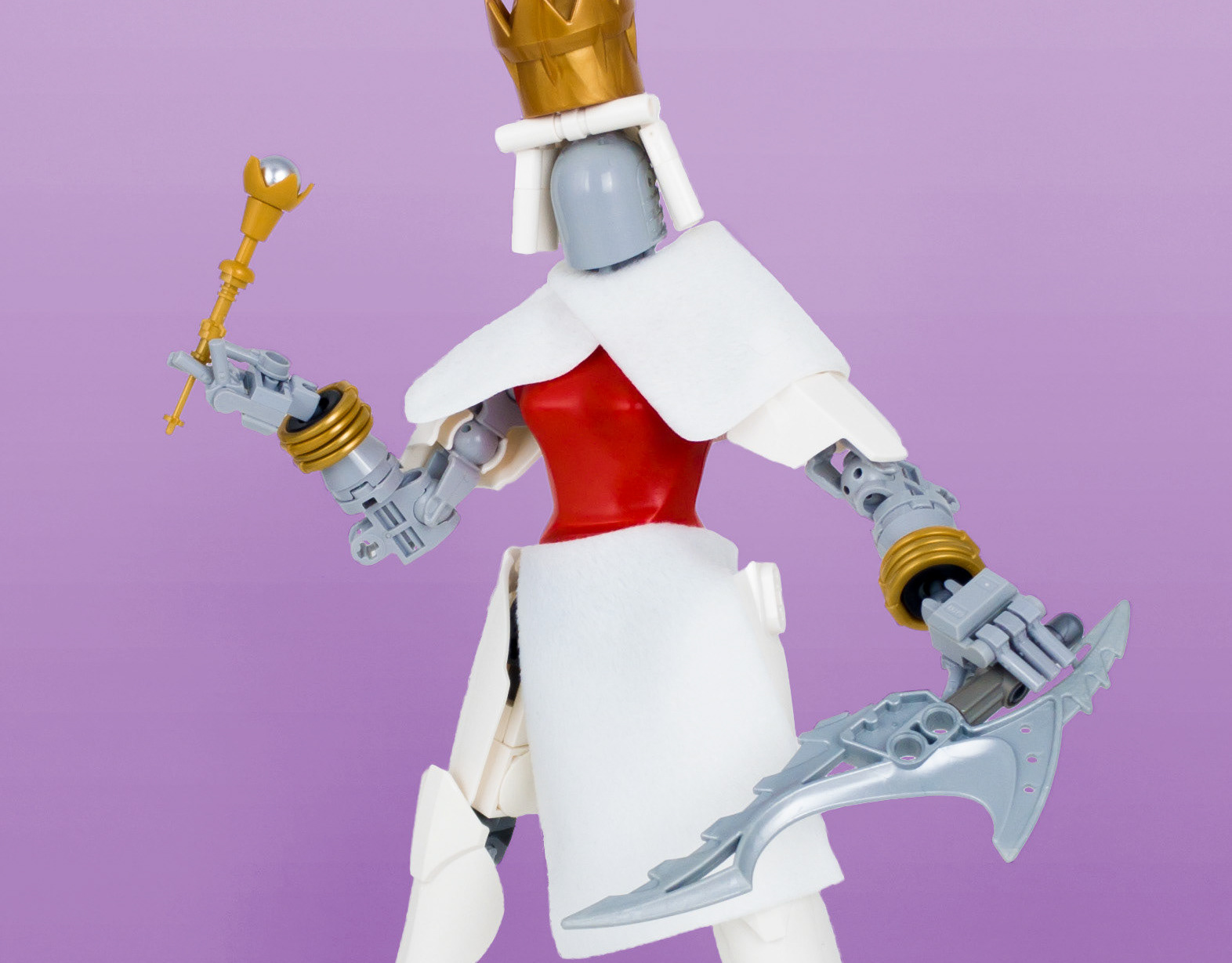
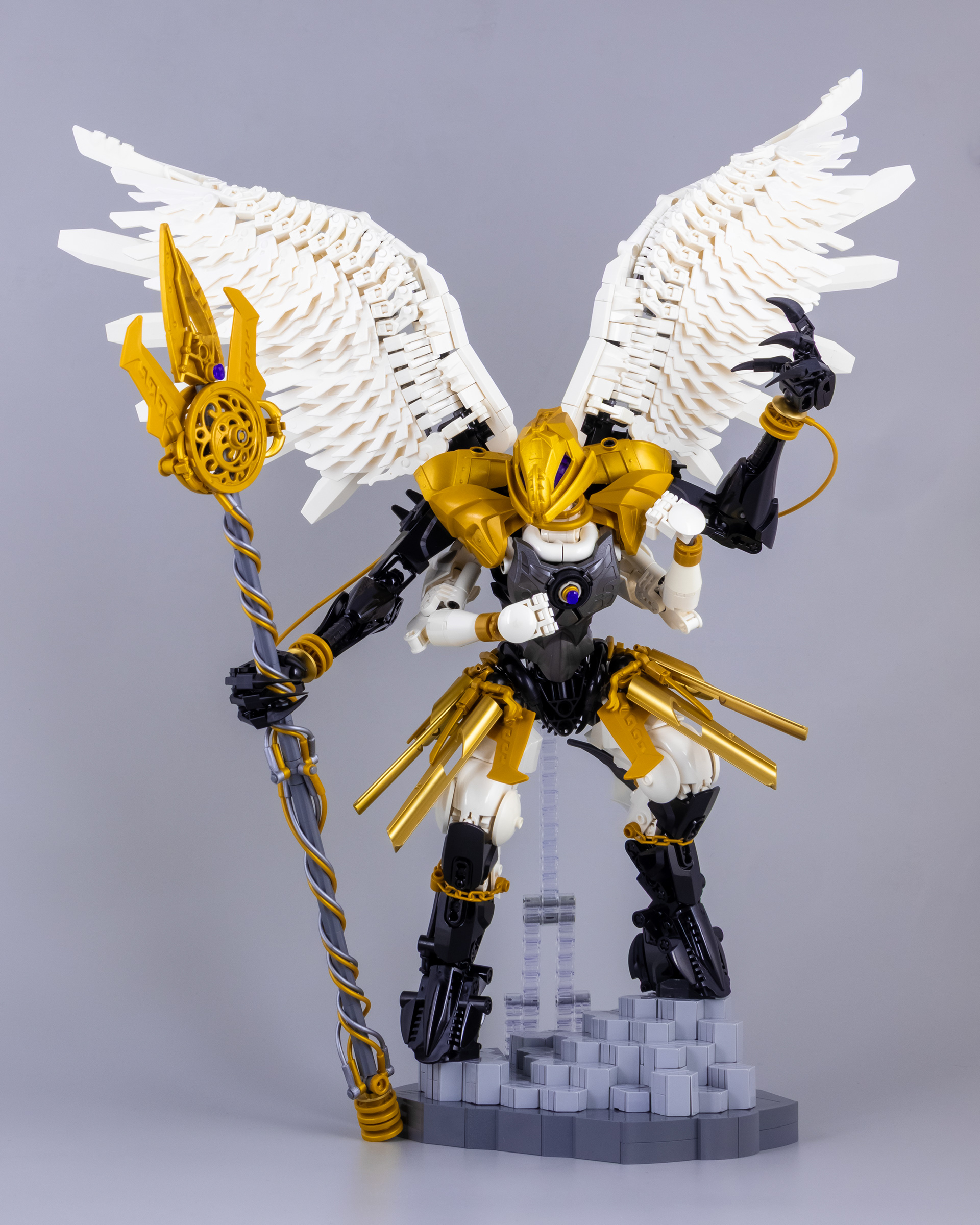
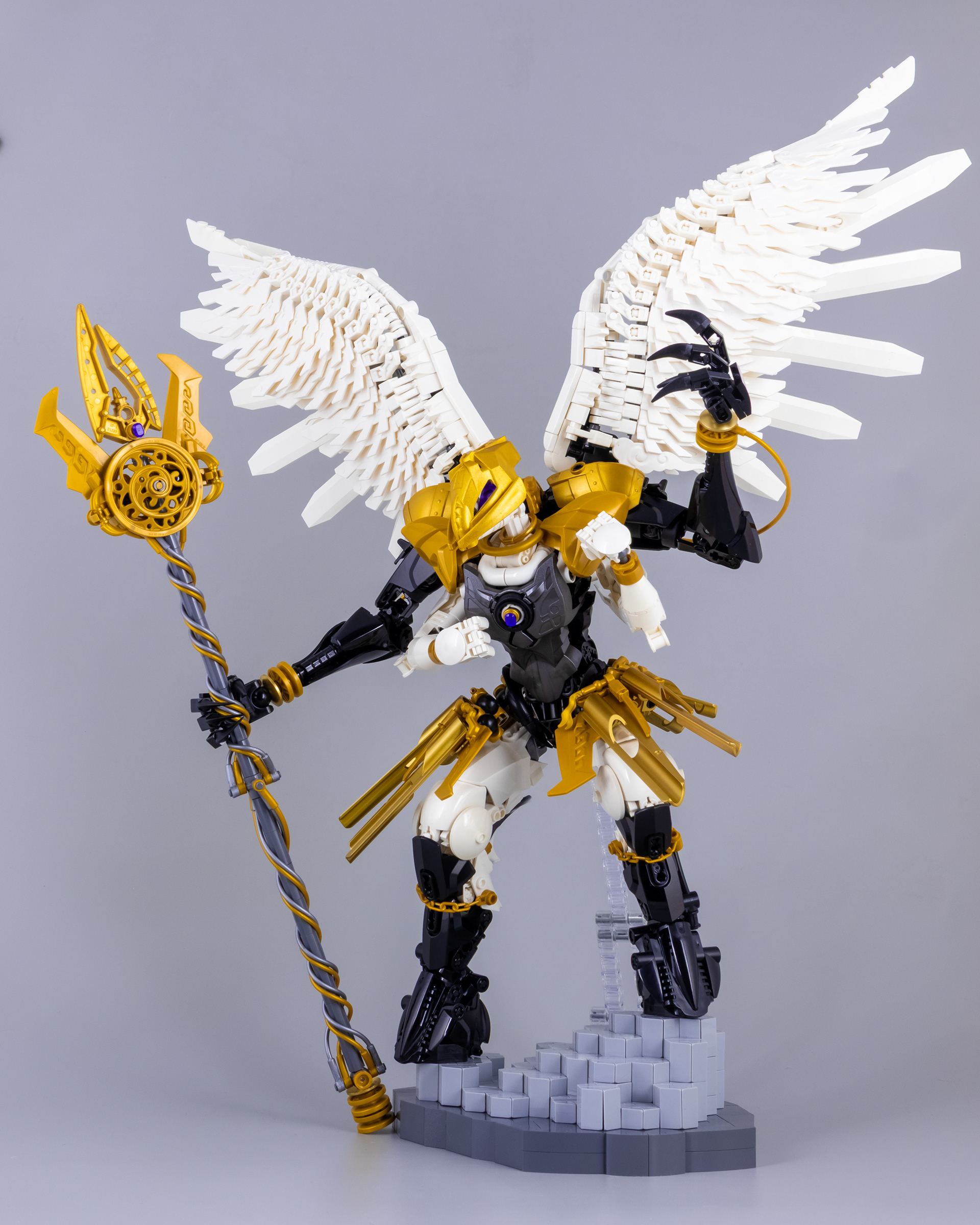
So, here is my design for exactly that. I had several years ago built a Makuta (and the alternate-universe light version as well), and iterating from parts of this as the core from which to build the fusion was natural. I took inspiration from several other fusion characters that had extra limbs from each of their constituents (notably, Allicio from Kill Six Billion Demons, Dawn Wings Necrozma — and also a bit of Nebilim as well). I imagined Takanuva having fused to Makuta’s back, adding his arms as a second pair, feathery wings instead of extra legs, and various pieces of golden armor (including some internals from a Knights Kingdom torso!). The color blocking reinforces this. Wherever he has golden armor, it is either on top of white pieces representing the Takanuva side, or there are gold strands that connect the armor back to Takanuva, as in the case of the bangles on Makuta’s wrists. His staff is adapted from the trident I made for my Makuta, but in addition to the silver ziplines crawling up its length there are gold as well representing the Toa, and a Chronicler’s staff at its tip gives further connection to Takanuva/Takua. As for the mask — well, I was always fond of the special-edition movie Kraahkan; a lovely cast of it in pearl gold by Socketball provided the ideal finisher for the fusion look.
Story-wise, Takutanuva is an imposing and nearly deific character, and when refining the build I wanted to emphasize this. His wingspan, certainly, helps contribute to this. I owe much to the incredible wing design of Nathan in his Virgo Dragon. I started from that design, and then iterated with refinements such as another layer of feathers using the Monkie Kid cloud element, and also with white threeves. The large base, on which he is perched with one leg raised, combined with his wide stance and outstretched arms — they’re all meant to evoke a bit of an air of grandeur, suitable for a powerful figure.
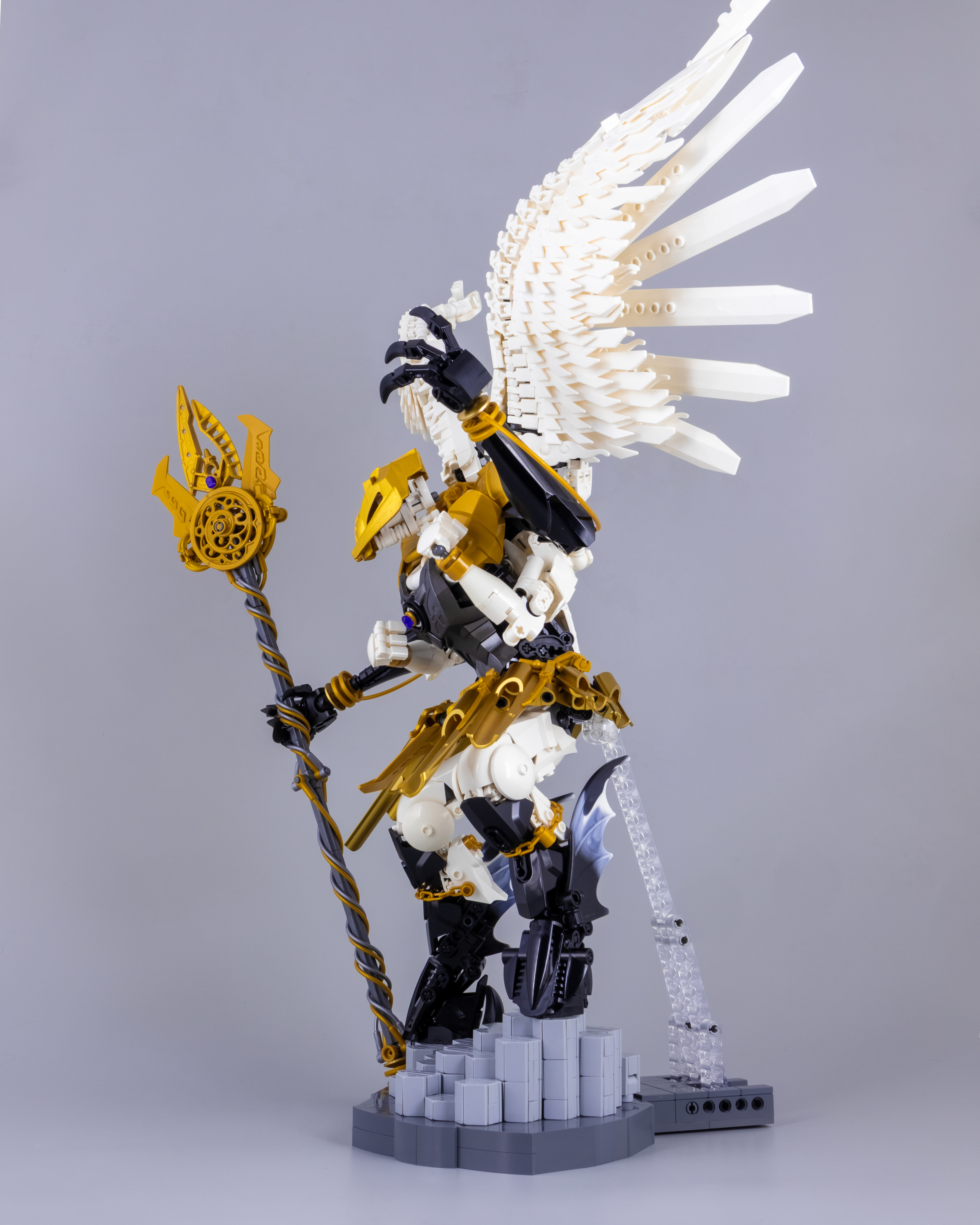
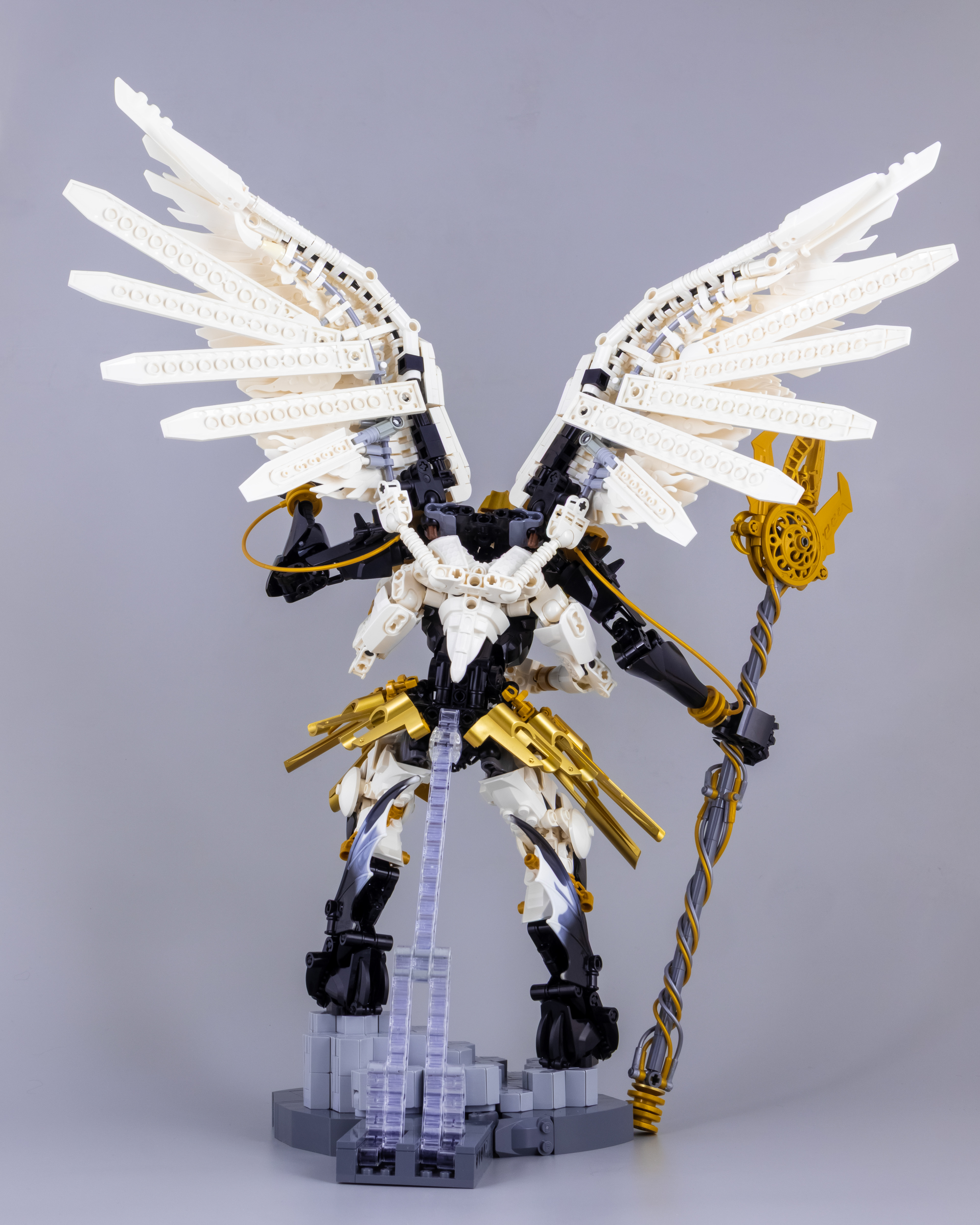
Let’s talk more about the base. Several years ago I stocked up on a lot of light bluish grey double cheese, inspired by the basalt column-like bases used on Pat’s Vakama and Anthony’s Plague Mech, and wanting to eventually use the technique myself. To make an imposing base for Takutanuva, I decided to try it out here. It turned out to be quite a learning experience! For one thing, it’s very parts-intensive. Many of my light bluish grey plates ended up in here. More than that, I realized the columns on their own are a pretty fragile technique, which is not a good realization for a base meant to anchor a heavy figure. One thing I did was ensure he was truly anchored into the columns, though designing the column under his left foot to have a stack of Technic bricks in the center that go up through his foot (a more built-up version of a what I’ve done on the base made for my Makuta of the Melding); as well as a stand from his rear to the back of the base, for good measure. But, more than these connections, I ensured that the columns were as integrated as I could make them, for stability. This was achieved partly by using long plates to connect rows of columns together (in some cases using up to 1x6 and 1x8 plates to connect groups), and partly by having the very bottom two-brick layer of the base connect the whole grid, by using round plates with through holes, and lots of bar elements. Finally, the bottom layer of dark bluish grey brick forms essentially a ring that locks it all together. Time-consuming and parts-intensive overall, and not even very prominent in the final photos, but worth the trouble!
Speaking of trouble, support for the wings was definitely up there! Although the main joints on the wings are connected using friction extenders on the body-side sockets, and ball joints here are much constrained by extra length of the axles through the bottom, this wasn’t enough to prevent them from flopping. Much trial and error at the eleventh hour of building was spent on figuring out how to get a second set of supports per wing, while also not making this reinforcement obtrusive from the front. My solution, as you can see in the back view, happily is obscured by the shoulder armor in the frontal view.
One last area of note: it’s subtle enough that I expect most folks wouldn’t spot it, but his legs are actually different lengths. It turned out that the step up in height from one foot to the other, combined with the amount of knee bend in the left leg, meant the right leg needed an extra unit of length. It has slightly longer thin Technic liftarms in the knee area, under the 3x3 radar dishes. Correspondingly, there’s some newer 1x3 round plates used on the right knee to connect those dishes, while the left makes do with just 1x2 round plates.
Bringing all these things together, I was extremely pleased with the end result. I think the photos capture him well (and, major props to Ari for a spectacular edit of the main shot’s background, perfectly capturing the style of the 2003 sets’ box art). But, there’s something to the build itself on my shelf that couldn’t fully be captured in photos. Astride the stone columns, with his wingspan all unfurled, arms stretched wide, looming over smaller builds like some great gargoyle — Takutanuva certainly has presence.